The Tornado Effect: Understanding Schooling Fish Behavior
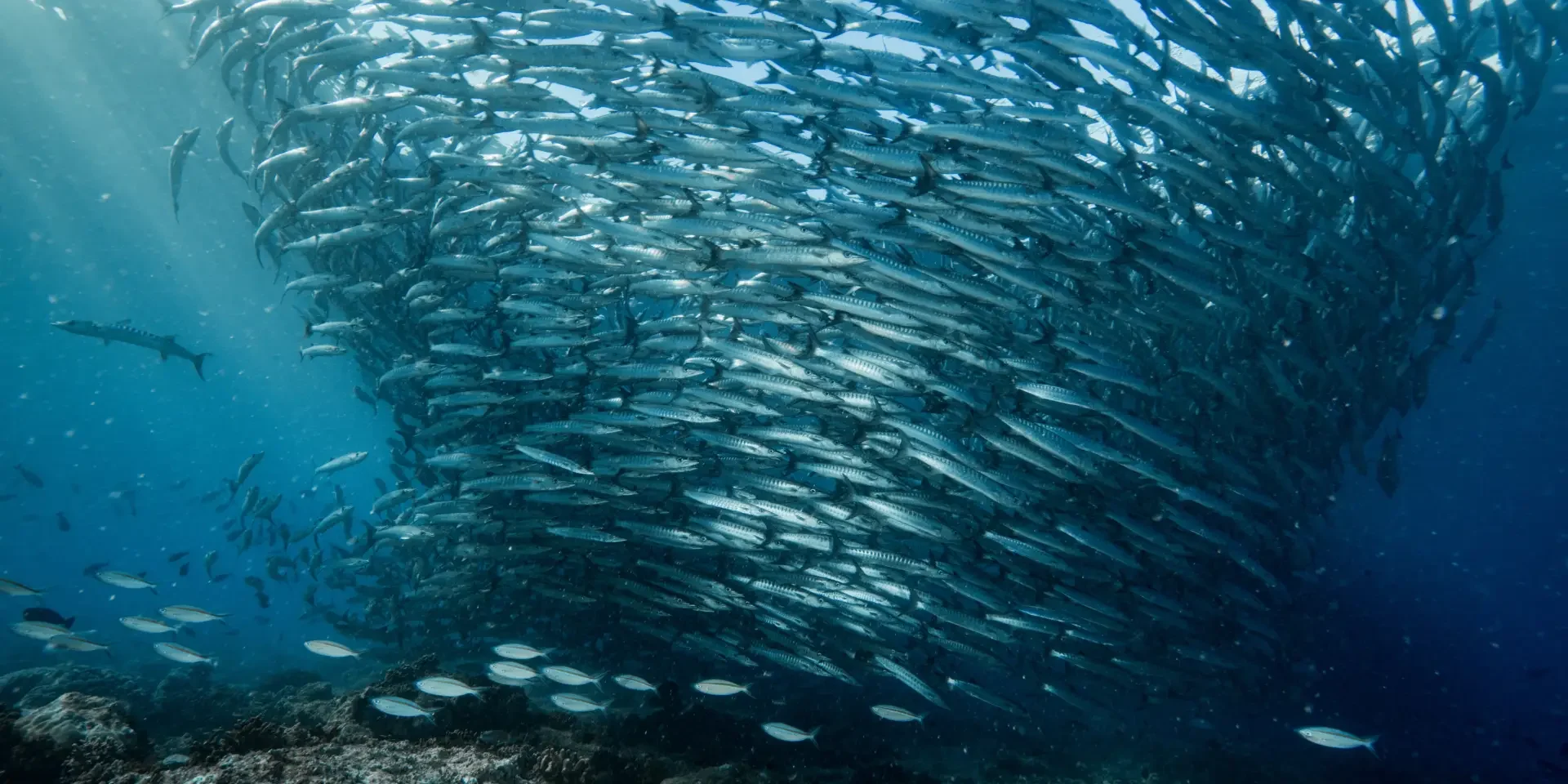
Of all the sights that a scuba diver can witness, few are as hypnotic as the “fish tornado.”
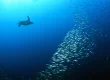
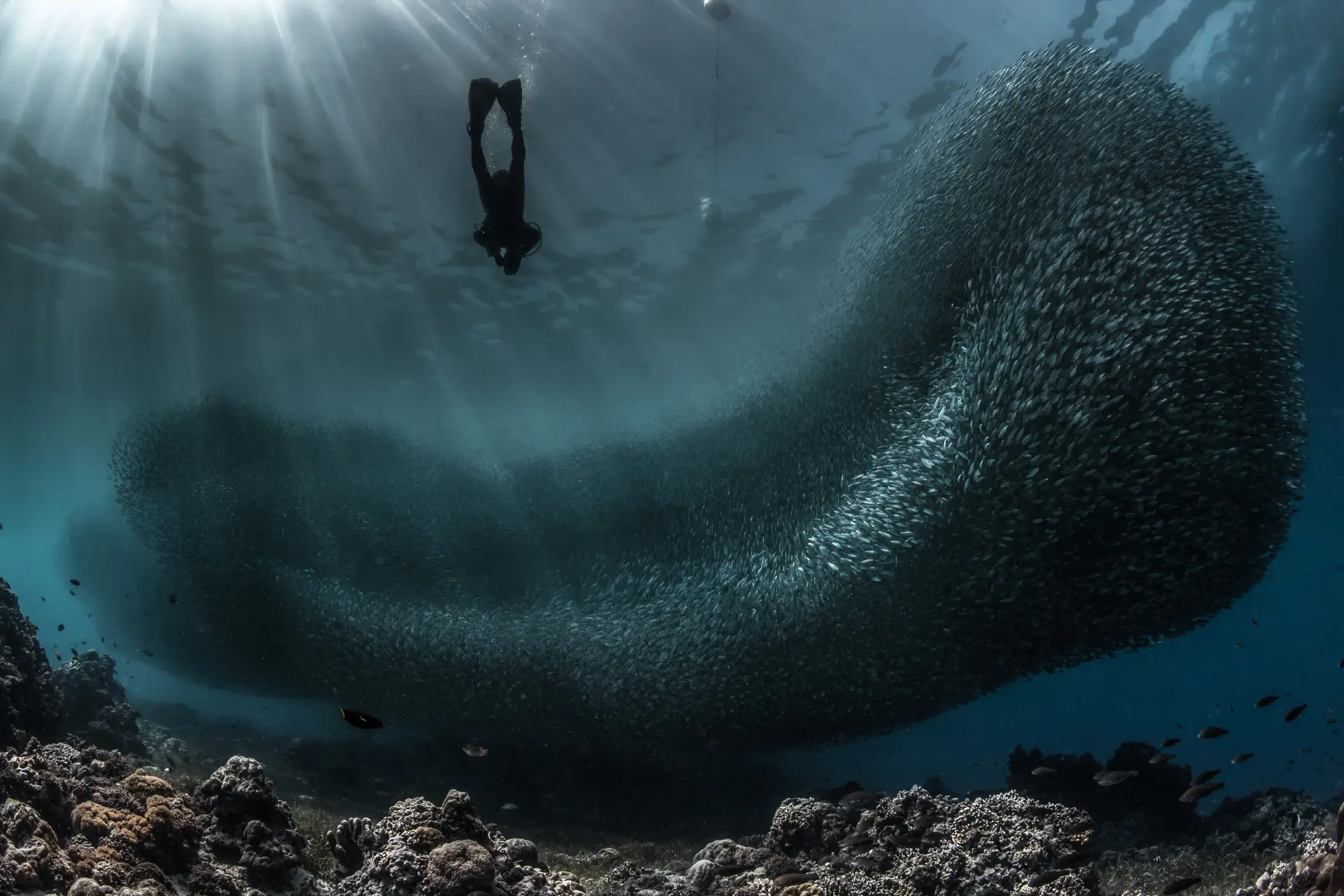
You see it first as a shimmering wall of silver in the distance. As you swim closer, the wall begins to curve and pulse, eventually spiraling into a massive, rotating cylinder that stretches from the seafloor toward the sunlit surface. To stand in the center of this vortex—surrounded by thousands of synchronized beating hearts—is to witness one of nature’s greatest displays of collective intelligence.
But what exactly is happening inside that vortex? Why do fish choose to move in such a complex, coordinated fashion, and how do they do it without a single “leader” calling the shots?
The “Why”: The Evolutionary Advantage of the Crowd
In the open ocean, there is nowhere to hide. For a mid-sized fish like a Jack or a Barracuda, survival depends on a strategy known as “The Dilution Effect.” Schooling is, essentially, a highly sophisticated defense mechanism.
1. Confusion and Defense
When a predator, such as a shark or a tuna, encounters a single fish, the target is clear. But when it encounters a school of ten thousand, the visual “noise” becomes overwhelming. The shimmering scales and constant motion make it nearly impossible for a predator to lock onto a single individual. This is known as “predator confusion.” By staying in the crowd, the individual’s statistical probability of being eaten drops significantly.
2. Hydrodynamic Efficiency
Much like professional cyclists “drafting” behind one another, fish in a school save energy. By swimming in the wake of the fish in front of them, individuals can reduce the amount of effort required to move through the water. This allows the school to travel longer distances at higher speeds with less caloric expenditure.
3. Foraging Power
Ten thousand sets of eyes are better than two. A school can scan a much larger area of the water column for plankton or smaller prey than a solitary fish could. Once food is found, the information spreads through the school almost instantaneously.
 The “How”: The Physics of Synchronized Motion
How do thousands of fish turn, dive, and spiral in perfect unison without crashing into one another? They don’t have a “general” giving orders; instead, they follow a set of decentralized rules programmed into their biology.
The secret lies in the Lateral Line System.
Running along the side of a fish’s body is a series of sensory organs that detect minute changes in water pressure and vibration. When the fish next to them moves, the change in pressure is felt instantly by everyone nearby. This allows for a reaction time that is significantly faster than visual processing alone.
Scientists have found that schooling behavior is generally governed by three simple rules:
-
Separation: Don’t get too close to your neighbor (avoid collisions).
-
Alignment: Match the speed and direction of your neighbor.
-
Cohesion: Move toward the average position of your neighbors (stay with the group).
When these three rules are applied by every individual in a group of ten thousand, the “Tornado Effect” emerges naturally as a response to current, light, or the presence of a diver.
The Iconic Vortex: The Jackfish of Balicasag
While you can see schooling behavior in many parts of the world, there is one location that has become synonymous with the “fish tornado”: Balicasag Island in Bohol, Philippines.
The Balicasag Marine Sanctuary is home to a legendary resident school of Big-eye Trevally (commonly known as Jackfish). While many schooling encounters are fleeting, the Balicasag Jacks are famous for their consistency. They have lived on these walls for decades, and because the area is a strictly protected “no-take” zone, they have become remarkably accustomed to the presence of scuba divers.
The Experience at “Rico’s Wall” or “Black Forest”
Typically found at depths between 10 and 25 meters, the Balicasag Jackfish school is a massive, silver living sculpture. As a diver, the experience is surreal. You can often hover just outside the school and watch as it slowly rotates in the current. If you remain calm and move slowly, the school will sometimes “open up” and surround you. For a few minutes, you are no longer a visitor; you are a part of the vortex. The sound of thousands of tails flicking in unison creates a low-frequency “hum” that you can feel in your chest.
Why Balicasag is Unique
The reason this specific school is so iconic is its density. The Big-eye Trevally (Caranx sexfasciatus) has a particularly reflective, metallic skin. When they school in the clear, turquoise waters of Bohol, they catch the sunlight in a way that creates a shimmering, chrome-like effect that is a dream for underwater photographers.
Photography Tips: Capturing the Vortex
Photographing a fish tornado requires a mix of technical skill and “fish sense.”
-
Go Wide: You need a wide-angle or fisheye lens to capture the scale of the school. If you use a macro lens, you’ll just get a wall of silver scales.
-
Ambient Light: Unless you are very close, strobes will often just illuminate the “backscatter” (particles in the water) between you and the school. Use the natural sun to your advantage; position yourself so the sun is behind you, illuminating the silver side of the fish.
-
Don’t “Bust” the School: If you swim aggressively into the center of the school, it will fragment and flee. Move slowly and predictably. Let the school come to you.
-
Look for the Shape: The school constantly changes shape. Wait for the moment it forms a perfect “O” or a “C” shape to create the most dynamic composition.
Beyond the Photo: The Lesson of the School
The “Tornado Effect” is a powerful reminder of the beauty of cooperation. In a world that often emphasizes individual strength, the schooling fish of Bohol prove that there is safety, efficiency, and even majesty in the collective.
The next time you find yourself diving in Bohol and the water turns to silver, take a moment to put the camera down. Stop swimming, find your neutral buoyancy, and simply watch. Being a part of the school—even for just a few minutes—is a profound connection to the rhythmic, synchronized heart of the ocean.