The Red Sea Lionfish: Native Predator, Global Invader
Few reef fish are as instantly recognizable as the lionfish. With its flowing venomous spines, bold striping, and slow, deliberate movements, the lionfish looks almost ornamental — a floating crown of fins drifting over coral. In the Red Sea, this striking predator is a natural and important part of the ecosystem. In the Caribbean, however, it tells a very different story.
Understanding the difference between native and invasive lionfish populations offers a powerful lesson in marine conservation, ecosystem balance, and the unintended consequences of human activity.
Meet the Red Sea Lionfish
The species most commonly encountered while diving in the Red Sea is Pterois miles, often called the devil firefish or Red Sea lionfish. It belongs to the Scorpaenidae family, a group that includes scorpionfish and stonefish.
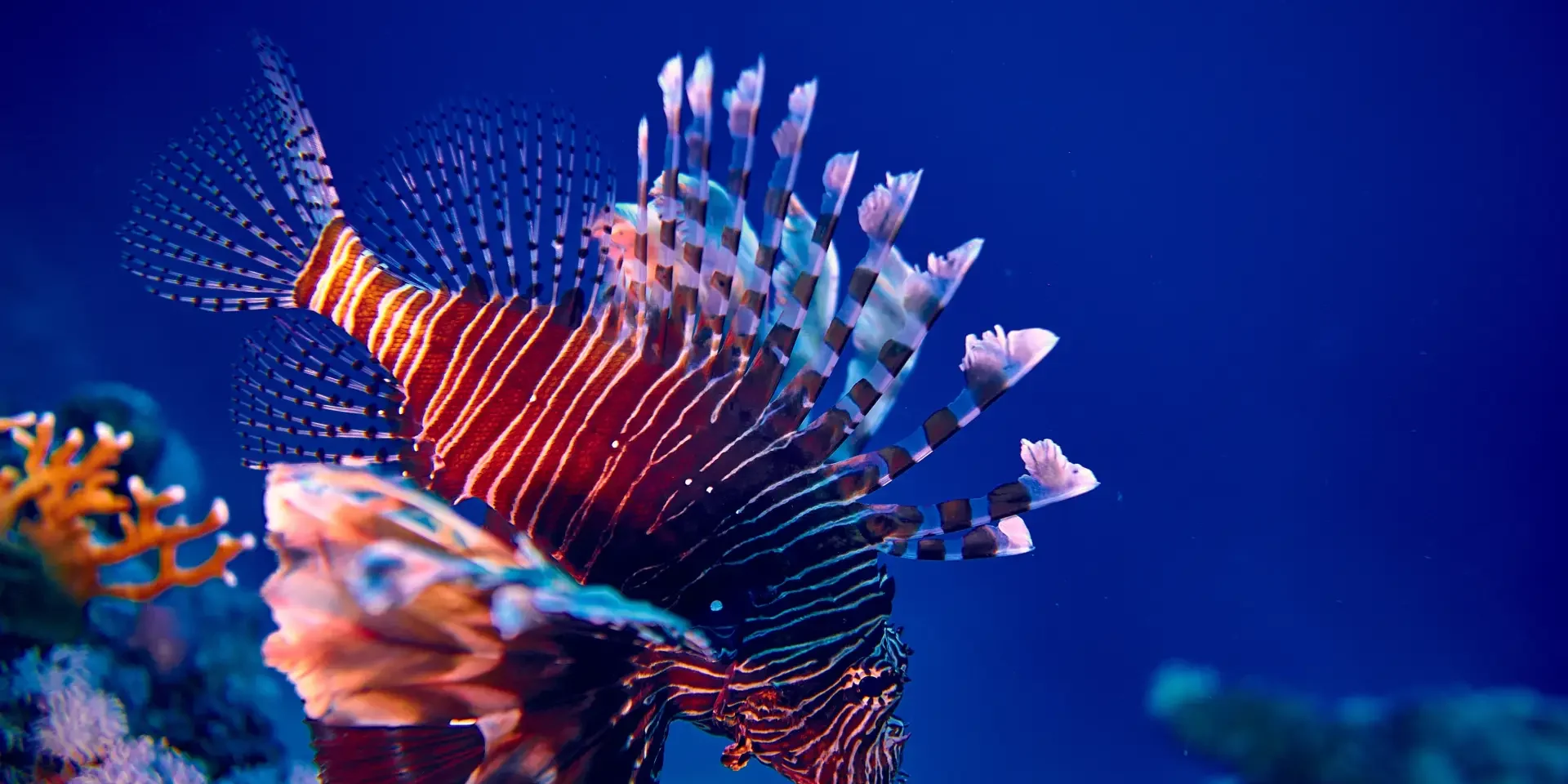
Recognizable features include:
- Long, fan-like pectoral fins
- Venomous dorsal spines
- Bold red, brown, and white vertical striping
- Slow, hovering swimming style
Despite their graceful appearance, lionfish are highly efficient ambush predators. They feed primarily on small reef fish and crustaceans, using their wide fins to corner prey before striking with remarkable speed.
A Native Predator in Balance
In the Red Sea and across much of the Indo-Pacific, lionfish evolved alongside other reef species over millions of years. This long-term coexistence created natural checks and balances.
In their native range:
- Other fish recognize lionfish as predators
- Larger predators may occasionally prey on juvenile lionfish
- Prey species have evolved avoidance behaviors
- Population numbers remain naturally regulated
Lionfish in the Red Sea play an ecological role similar to that of other mid-level reef predators. They help maintain reef biodiversity by controlling populations of smaller fish, preventing any one species from dominating.
For divers exploring reefs around Hurghada or further south, spotting a lionfish tucked beneath a ledge or drifting over coral bommies is a common and natural part of the underwater experience.
The Caribbean Invasion
The conservation story changes dramatically when we look westward.
In the 1980s and 1990s, lionfish — primarily Pterois volitans (red lionfish) and some Pterois miles — were introduced into Atlantic waters, likely through accidental or intentional aquarium releases in Florida.
From there, they spread rapidly throughout:
- The Caribbean Sea
- The Gulf of Mexico
- The western Atlantic
Without natural predators or ecological controls, lionfish populations exploded.
Why Lionfish Became a Problem in the Caribbean
1. No Natural Predators
Native Caribbean predators did not recognize lionfish as prey. Their venomous spines also deter most potential hunters.
2. Naïve Prey Species
Small reef fish in the Caribbean had never evolved alongside lionfish. They did not instinctively avoid them, making them easy targets.
3. High Reproductive Output
Female lionfish can release tens of thousands of eggs every few days. This rapid reproduction allowed populations to expand at alarming rates.
4. Broad Diet
Lionfish consume a wide variety of juvenile reef fish, including important herbivores that help control algae growth on coral reefs.
In some Caribbean reef systems, lionfish reduced native juvenile fish populations by more than 60–70% in a short period.
Native vs. Invasive: Same Fish, Different Impact
The difference between Red Sea lionfish and Caribbean lionfish is not about the fish itself — it’s about ecosystem balance.
In the Red Sea:
- Lionfish are part of a stable food web
- Reef species evolved alongside them
- Populations are naturally integrated
In the Caribbean:
- Lionfish arrived without ecological context
- No evolved predator-prey relationships exist
- They disrupt reef resilience and recovery
This contrast highlights a critical conservation principle: a species that is perfectly healthy and natural in one ecosystem can become ecologically damaging in another.
Conservation Efforts in the Caribbean
Unlike in their native range, lionfish are actively managed in the Caribbean.
- Organized lionfish removal dives
- Spearfishing programs
- Public awareness campaigns
- Encouraging lionfish as a food fish
In many areas, divers are trained to safely harvest lionfish to reduce their impact on reef systems. Restaurants in parts of the Caribbean even promote lionfish dishes as a sustainable seafood option.
This kind of intervention is necessary only because lionfish lack natural controls in the Atlantic.
Why Red Sea Lionfish Should Not Be Targeted
In the Red Sea, lionfish are not invasive. They are a native species fulfilling an ecological role. Removing them indiscriminately would disrupt reef balance rather than protect it.
This distinction is crucial for divers who may travel between regions. A lionfish spotted while diving in the Red Sea is a normal and healthy component of that ecosystem — not a threat.
The Bigger Conservation Lesson
The lionfish story is ultimately about human impact.
The aquarium trade — responsible for introducing lionfish to Atlantic waters — illustrates how even small, seemingly harmless actions can ripple through entire ecosystems.
It also reminds us that:
- Marine ecosystems are finely balanced
- Species introductions can have long-term consequences
- Prevention is far more effective than correction
Seeing Lionfish in the Red Sea
For divers in the Red Sea, lionfish encounters are often memorable. They are frequently seen:
- Hovering under overhangs
- Sheltering in caves
- Hunting at dusk or during night dives
- Fanning their fins over coral heads
Because they move slowly and confidently, they make excellent photography subjects. However, divers should always maintain safe distance and avoid contact due to their venomous spines.
Despite their fearsome appearance, lionfish are not aggressive toward humans. Injuries typically occur only through accidental contact.
A Tale of Two Oceans
The Red Sea lionfish represents a powerful example of how context shapes conservation. In one ocean, it is a native predator maintaining balance. In another, it is an invasive species requiring active management.
By understanding this difference, divers gain a deeper appreciation not only for lionfish themselves, but for the delicate interconnectedness of reef ecosystems worldwide.
The next time you encounter a lionfish drifting effortlessly above a Red Sea reef, remember: here, it belongs. And its presence tells a story — not of invasion, but of evolutionary harmony within one of the planet’s most spectacular marine environments.