5 Marine Species You’ll Find in The Philippines But Not The Caribbean
If you learned to dive in the Americas, there is a good chance your logbook is packed with Caribbean entries. And why wouldn’t it be? The Caribbean offers spectacular visibility, massive barrel sponges, playful nurse sharks, and those iconic, graceful spotted eagle rays. It’s accessible, warm, and reliably beautiful.
But eventually, every diver hits a point where they want to see something completely different. You start hearing rumors on the dive boats about the “Coral Triangle”—a massive region in Southeast Asia that boasts the highest marine biodiversity on the planet. The Philippines sits right at the heart of this triangle. To put it in perspective, the Caribbean is home to around 60 to 70 species of hard corals. The Philippines? Over 500. That explosive diversity at the base of the food chain means the waters are absolutely swarming with bizarre, alien-like critters that simply do not exist in the Western Hemisphere.
If you’re thinking about making the long-haul flight across the Pacific, here are five incredible marine species you can find in the Philippines that you will never see on a Caribbean reef.
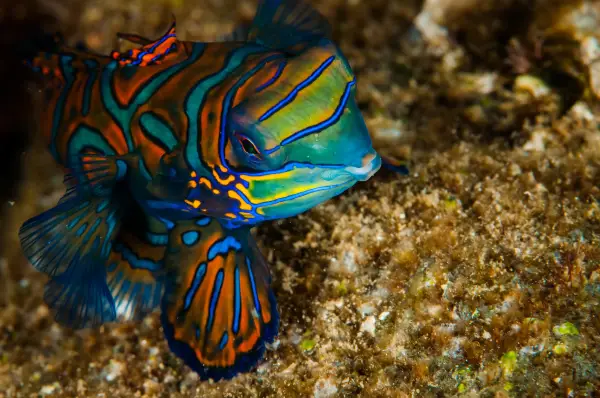 1. The Mandarinfish (Synchiropus splendidus)
If there were an underwater beauty pageant, the Mandarinfish would win it without breaking a sweat. These tiny, incredibly shy fish look like they were painted by a hallucinogenic artist. They feature a base of deep velvet blue overlaid with psychedelic, swirling orange and green lines.
You won’t find them swimming out in the blue or hanging around standard coral heads. Mandarinfish are exclusively found hiding inside branching corals (often finger coral or staghorn). Getting a glimpse of them requires a very specific type of dive: the sunset dive. Mandarinfish are notoriously active at dusk, which is when they perform an elaborate, romantic mating dance. The male and female will slowly rise cheek-to-cheek from the safety of the coral branches, release their eggs and sperm into the water column in a split-second burst, and instantly dart back down into the reef. It’s a holy grail moment for macro photographers and requires a lot of patience, good buoyancy, and a red-light focus torch.
2. Bargibanti Pygmy Seahorses (Hippocampus bargibanti)
Finding a seahorse in the Caribbean is always a treat, but the seahorses in the Indo-Pacific take things to a microscopic level. The Bargibanti pygmy seahorse is a true master of disguise. These guys max out at around two centimeters long—about the size of your pinky nail—and they live their entire adult lives on specific species of Muricella gorgonian sea fans.
What makes them so spectacular is their camouflage. Their bodies are covered in calcified bumps that perfectly mimic the polyps of their host sea fan, and they literally take on the exact color of the coral (usually bulbous pink or pale yellow). You can stare directly at a sea fan for five minutes and never spot one until a sharp-eyed local dive guide points it out with a metal muck stick. If you happen to be diving Balicasag, which is famous for its dramatic plunging walls covered in massive gorgonian fans, you’ll definitely want to spend some time inspecting the branches closely.
3. The Flamboyant Cuttlefish (Metasepia pfefferi)
Caribbean reef squid are fascinating to watch, but they don’t hold a candle to the sheer weirdness of the Flamboyant Cuttlefish. First of all, this creature rarely swims. Instead, it uses its bottom arms and a pair of fleshy flaps on its mantle to literally “walk” across the sandy ocean floor like a tiny, colorful alien tank.
While most cuttlefish use their chromatophores to blend into the background, the Flamboyant Cuttlefish does the exact opposite when threatened. It flashes a vibrant, pulsating warning display of yellow, maroon, and bright purple. It’s putting on this flashy light show for a very good reason: its muscle tissue contains a highly toxic compound, making it one of the few poisonous cephalopods in the world. They are typically found in shallow muck diving sites, hunting tiny crustaceans in the black volcanic sand.
4. Ornate Ghost Pipefish (Solenostomus paradoxus)
Imagine a fish that has evolved to look exactly like a piece of floating debris or the feathery arms of a crinoid (feather star). The Ornate Ghost Pipefish is a relative of the seahorse, but it floats upside down, suspended perfectly still in the water column, blending in seamlessly with its surroundings.
They have elongated snouts used to suck up microscopic shrimp, and their bodies are covered in spiky, leaf-like appendages. They come in a variety of colors depending on their habitat—from deep black and red to translucent yellow. Spotting them is incredibly difficult because your brain naturally registers them as a piece of dead seagrass swaying in the current. They usually hang out in pairs, often tucked inside the protective arms of a host feather star or hovering near the sandy bottom next to a coral bommie.
5. The Blue-Ringed Octopus (Hapalochlaena)
The Caribbean has the common octopus, which is notoriously smart and fun to interact with. The Philippines has the Blue-Ringed Octopus, which is tiny, adorable, and possesses enough venom to kill 26 adult humans within minutes.
Usually no larger than a golf ball, this incredibly elusive cephalopod spends most of its time hiding in empty shells, discarded bottles, or small crevices in the rubble. When it feels threatened, bright, iridescent blue rings suddenly flash across its yellowish body as a stark warning. Despite their deadly reputation (they carry tetrodotoxin, the same neurotoxin found in pufferfish, produced by bacteria in their salivary glands), they are completely docile and will only bite if provoked, stepped on, or handled. If you are scuba diving bohol and scanning the sandy bottom or rubble patches during a night dive, keeping an eye out for these little flashing neon rings is an absolute thrill.
Trading the Sponges for the Strange
The Caribbean will always hold a special place in the hearts of divers. It’s the perfect place to drift along a massive reef wall, spot cruising pelagics, and enjoy fantastic visibility. But if you are a diver who loves the weird, the rare, and the microscopic, the Indo-Pacific is calling your name.
The Philippines offers a completely different underwater reality. It’s a place where you stop looking out into the blue and start staring at a single patch of sand or a single sea fan for twenty minutes, marveling at the sheer, unfiltered creativity of marine evolution. If you haven’t made the trip to Southeast Asia yet, it’s time to add it to the very top of your scuba bucket list.